Austin, TX - Where a Goldmine of Local History, Maps Authority, and AI Visibility Converge

Intro summary: This isn't an experiment. It's the convergence of the disciplines a small local business actually needs today: Maps ranking and citation, podcast and local media presence, and inclusion in AI-generated summaries — all wrapped inside a soft-sell, crowdsourced local history and economic development media project. It blurs the line between academic and history experts, authors, local service businesses, local bars, and the followers who already care about their community, to the benefit of any small business attached to it in any stakeholder role.
Every market I've built a Behind Bars Network project in — Delaware County, Hudson County — shares one thing: a real, documented history sitting next to businesses that need to be found. Austin has both of those in a more concentrated form than almost anywhere else I've looked.
It's one of the fastest-growing large cities in the country. It's one of the best cities in America to start a small business. And it sits on top of one of the most thoroughly archived city histories in Texas. That combination — explosive growth, brutal local competition, and deep documented history — is exactly where this convergence compounds the fastest. This article lays out why, and there's a link at the bottom if you want to talk through what an Austin project, or any project like it, could look like for your business.
Table of Contents
- A City Growing Faster Than It Can Be Found
- Small-Business Density Meets Brutal Local Competition
- A History Infrastructure Few Cities Can Match
- Anchor Institutions With Real, Verifiable Stories
- A Built-In Audience: Tourism and Search Volume
- Why This Moment Matters for Maps and AI Summaries
- What an Austin Project Could Look Like
- How Sponsors Get In at a Discount
- Talk to Me About It
- FAQ
A City Growing Faster Than It Can Be Found
Austin crossed one million residents in 2025, officially becoming the 12th most populous city in the country, according to the City of Austin's own planning department.
- 1,002,632 residents as of 2025 — Austin's first time over the one-million mark.
- +2.1% metro growth in a single year — fastest among all major Texas metros, ahead of Houston, Dallas, and San Antonio, per American City Business Journals data.
- ~54,000 new residents added in that same year alone.
- +2 million residents projected for the region by 2060, according to Opportunity Austin's regional projections.
That matters for an authority project in a very specific way: a city adding tens of thousands of people a year is full of newcomers who have no idea which bar, which lawyer, or which contractor has actually been there for decades and which just opened last quarter. That's a search and AI-summary problem before it's anything else — and it's precisely the gap a documented local history project is built to close.
Small-Business Density Meets Brutal Local Competition
Austin isn't just growing — it's one of the most small-business-friendly cities in the country, which cuts both ways for the businesses trying to stand out in it.
- #2 large U.S. metro for starting a small business, per a 2026 CoworkingCafe analysis reported by Austin Founders Feed.
- 2,300+ new businesses registered per 100,000 residents in 2024 — well above the national average of 1,553.
- 12,415 small businesses per 100,000 residents, against a national figure of 10,376.
- 48.1% of local employment comes from small businesses, above the 45.9% national benchmark.
- Named best U.S. city to start a business in 2025, with 7,000+ business births in 2024 and a 13.5% new-business entry rate, according to the McCombs School of Business at UT Austin.
That's a genuinely great environment to open a business in — and a genuinely difficult one to be found in. When thousands of new competitors enter the market every year, the businesses with real, documented, citable authority are the ones that keep surfacing in Maps and AI answers while the rest fight over scraps of visibility.
A History Infrastructure Few Cities Can Match
Most cities don't have the raw material to support a documentary-grade local history project. Austin does, in a way that's unusually well organized for an outside producer to work with.
The Austin History Center — the local history division of the Austin Public Library — has been collecting and preserving Austin and Travis County records since before the city's founding in 1839, according to the Texas State Historical Association. Its holdings include:
- 1,200+ manuscript collections spanning thousands of linear feet of boxes
- 700,000+ photographs
- ~1,000 historical maps
- Oral histories from 400+ local residents and public figures, per the Austin Public Library's own collections page
Layer on top of that the University of Texas at Austin's Briscoe Center for American History, the Perry-Castañeda Library's map collection, and the Portal to Texas History, and Austin has genuine, citable, primary-source infrastructure sitting a few blocks away from the businesses that could benefit from it. That's not something I have to build from scratch here — it's something I get to plug into.
Anchor Institutions With Real, Verifiable Stories
An authority project is only as strong as its anchor. Austin has one of the strongest anchor candidates I've come across in any market: Scholz Garten.
- 1866 — German immigrant August Scholz opens the saloon and beer garden at 1607 San Jacinto Boulevard.
- 160 years of continuous operation as of August 1, 2026 — through Prohibition, two world wars, and, as one recent local history piece put it, "one air-conditioning rebellion," per Austin Texas Things.
- Oldest continuously operating tavern in Texas, per the Texas State Historical Association.
- Recorded Texas Historic Landmark since 1967, and on the National Register of Historic Places since 1979.
That level of independent verification is something most modern "established since" marketing claims simply can't touch.
Scholz Garten doesn't have to carry the whole series alone, either. Austin has a real bench of multigenerational institutions:
- The Driskill Hotel — open since 1886
- Dirty Martin's Place — serving burgers on the Drag since 1926
- Cisco's — a longtime meeting spot for Austin mayors, Texas governors, and even Lyndon B. Johnson
Every one of those names is independently documented, which is the entire foundation an EEAT-driven project has to be built on.
A Built-In Audience: Tourism and Search Volume
Austin isn't a hidden market that needs to be introduced to an audience — it already has one.
- ~30 million visitors welcomed to the region in 2024.
- $11.1 billion in economic impact generated.
- ~148,000 hospitality and tourism jobs supported, according to Visit Austin data reported by OysterLink.
- 21.76 million airport passengers through Austin-Bergstrom International in 2024, with traffic still climbing into 2026.
Every one of those visitors, plus the residents moving in every year, represents search demand for "best," "oldest," and "where to go" queries — exactly the kind of question an AI summary or Maps result now answers before a person ever opens a review site.
Why This Moment Matters for Maps and AI Summaries
Timing matters here as much as the city itself. Google's own guidance on creating helpful, people-first content is explicit that trust is "the most important aspect" of E-E-A-T, and that experience, expertise, and authoritativeness all feed into it — with clear sourcing and demonstrated background called out directly as signals its systems look for.
Separately, recent tracking from theStacc's local search data study shows:
- ~78% of restaurant-related queries now trigger an AI Overview, up from about 10% in late 2024.
- AI local packs typically surface only one or two businesses — down from three in a traditional pack.
- AI local packs weigh content authority and topical relevance more heavily than simple proximity.
- Businesses cited inside an AI Overview see roughly 35% higher organic click-through than those left out.
- Businesses excluded from an AI Overview lose visibility for that query entirely.
In a market growing this fast, with this much small-business turnover, that's not a small detail. The businesses that get documented, sourced, and cited now — while the field is still relatively open — have a real head start over the ones who wait until the AI-summary era is fully mature and the citation slots are already claimed.
What an Austin Project Could Look Like
I'm not proposing a finished product — I'm proposing the same model I've already run in Delaware County, Pennsylvania, and Hudson County, New Jersey, applied to Austin's specific history and market. That means:
- Pairing historians, authors, and academics — many already connected to the Austin History Center or UT Austin's archives — with multigenerational anchor institutions like Scholz Garten.
- Giving other local businesses a way to sponsor or get featured alongside that story: a dedicated sponsor page with real backlinks, an interview feature, a media kit, and social distribution across every channel involved.
- Structuring it as an à la carte model, so anchor businesses, historians, sponsors, and adjacent local service businesses can each join at whatever level makes sense — at launch, or years down the road, since the archive never closes.
How Sponsors Get In at a Discount
Sponsoring one of these series isn't priced like a typical marketing package, and it doesn't have to be. Bars, pubs, and other qualifying anchor sponsors get a partner rate up front — and that rate can drop to $0 once we're allowed to use their result as a case study with the contractors and local service pros who already follow them on social.
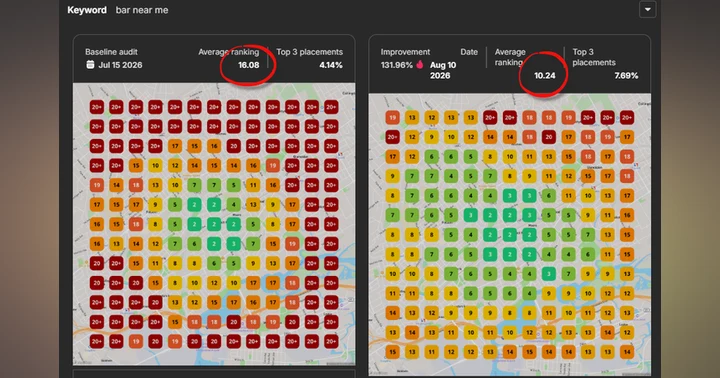
Here's why that works. We already proved it in Hudson County, New Jersey: Piccolo's, a multigenerational Hoboken cheesesteak shop, went from ranking 20th to ranking 4th for "cheesesteak near me" within a 3-mile radius, brought in as a local landmark sponsor through our Maps optimization and social systems. That's a real, verifiable jump — not a marketing claim.
- A pub or a cheesesteak shop with a few thousand hardcore fans and followers is sitting on an asset most marketing packages never touch: an audience of contractors, tradespeople, and local service pros who already trust that business.
- The moment a proprietor can point to a real before-and-after — 20th to 4th, for example — and say it out loud to the contractors who eat there every week, that's a more credible pitch than any cold outreach we could run ourselves.
- Those contractors live and die by phone calls. A fan who already trusts the bar or the shop, hearing that result directly from the owner, is exactly the kind of prospect who's ready to sign up.
- As soon as a few of those contractor-fans convert, the sponsor's rate for their own Maps and social management starts stepping down — potentially to nothing.
That's the lane that makes this service make sense for a bar or a cheesesteak counter that would otherwise call it too pricey. The anchor business, the historians and authors, the contractors, and every local legend that follows the story all end up in the same mix — and the same discount structure would apply to Austin's anchor sponsors and adjacent local service businesses just as it does in Hoboken.
Talk to Me About It
This is a good fit if you're:
- An Austin bar, tavern, or restaurant with real multigenerational history
- A historian or academic connected to Austin's archives
- A local service business tired of losing the Maps and AI-summary battle to competitors with a thinner story than yours
I'd rather talk it through directly than have you wait for a formal launch. Book a free AI-visibility and authority audit below, covering Maps positioning, podcast and sponsorship opportunities, and AI summary visibility — or reach out directly at gm@behindbars.network.
Book a free AI-visibility & authority audit →
FAQ
Why is Austin a good fit for a history-driven authority project?
Austin combines three things a project like this needs:
- Explosive population and business growth that creates real search demand
- An unusually well-documented city archive through the Austin History Center and UT Austin's collections
- A bench of verifiable multigenerational anchor institutions like Scholz Garten
Few markets have all three at this scale.
Why does Scholz Garten keep coming up as the anchor?
Scholz Garten is independently recognized by the Texas State Historical Association as the oldest continuously operating tavern in Texas, dating to 1866, with a Recorded Texas Historic Landmark designation and a National Register of Historic Places listing. That level of documentation is exactly what an EEAT-optimized series needs as a foundation — though other verified Austin institutions like the Driskill Hotel or Dirty Martin's could anchor future installments.
How does Austin's growth actually help local businesses here?
It doesn't automatically help — it raises the stakes. Austin's population and small-business base are both growing faster than almost any other major U.S. metro, which means more competition for the same searches and AI-summary citations. Businesses that get documented and cited early, through a real community story, have an advantage over the wave of new competitors still building a presence from zero.
What kind of businesses can get involved?
- Multigenerational bars, taverns, and restaurants with a real story to anchor an episode
- Historians, academics, and authors who can supply verified research, many already connected to Austin's archives
- Local service and brick-and-mortar businesses that sponsor or get featured alongside the story
- Sponsors or distribution partners like chambers of commerce and business networking groups
How does the sponsor discount actually work?
Qualifying anchor sponsors — bars, pubs, and similar local landmarks with a real fan base — get a partner rate to start. That rate steps down, sometimes to $0, once we're allowed to use their real Maps result as a case study with the contractors and local service pros who already follow them on social. We proved the model in Hudson County, New Jersey, where Piccolo's, a multigenerational Hoboken cheesesteak shop, moved from 20th to 4th for "cheesesteak near me" within a 3-mile radius as a local landmark sponsor. The same structure applies to Austin's anchor sponsors.
How do I get in touch or learn more?
Book a free AI-visibility and authority audit through the scheduling link on this page, or email gm@behindbars.network directly. Sponsorship spots, feature interviews, and Maps-positioning consultations are open now for any Austin business or historian with a real story to tell.

The Emerald Triangle: DelCo Irish History Docuseries — and the Authority Engine Behind It